DataKiosk is a KDE database tool that lets you (through an series of Kdevlop style wizards) create custom database query API styles for data access. Anyone familiar with Juk will understand how well this kind of functionality works on generic table structures. Here is a flash demo to help convey the concept. Currently it in KDE CVS (kdeextragear-1)and available for testing.
Month: February 2005

Learning to Share
Another site claiming to be “The Vault” has a quick how to on setting up KDE Public File Server (aka kpf.) Kpf lets you share files with other users across a network using http. Its basically a personal web server that doesn’t require administrator rights to use and is fully manageable from your KDE desktop. The tutorial is light on information but has screen shots. Oh, and FYI yes those Max OSX looking dialogs are KDE dialogs. KDE/Kwin can be made to look like almost any desktop; OSX, Solaris, CDE, or even one from a company in the northwest United States (who shall remain unnamed.)
What am I Doing Wrong?
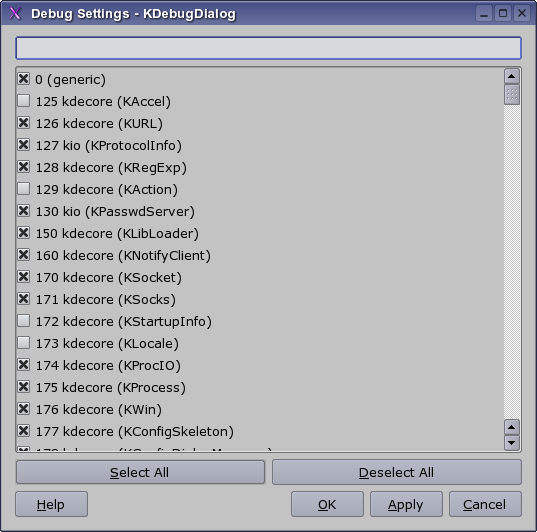
A particularly useful KDE application when developing, testing, or debugging is kdebugdialog. It is a single dialog box that lets you turn on/off all of the various debugging, error, and stderr messages for each KDE application and each debugging level. Thankfully, the dialog includes search functionality.
KDE Tips
News Forge has a article on Tips an Tricks in KDE, covering topics like advanced kwin usage and rendering GTK+ apps with Qt. Some of the stuff they talk about I have already discussed previously. Why are people still using Gnome?
The Power of KDE
One of the most advacned development tools of any environment is KDE’s UI scripting environment (aka DCOP) and a GUI scripting tool by the name of Kommander.
Kommander may be a revolution in application development, unlike any other tool created for scripting. What Kommander does is essentially extends the power of RDE to scripting. Language support include Bash, sh, Csh, Zsh, straight DCOP, or even Javascript. linux.com has a two part series on Kommander that should be required reading for anyone who is starting to do development on the Linux/KDE platform.
What is amazing is that the bulk of execution time is actually done by the KDE application binaries themselves; meaning that Kommander applications run almost as fast as stright C++/KDE/QT apps. Peviosuly I have talked about kdialog and its uses as a GUI interface for commandline scripts. Kommander takes this functionality to the Nth power.
Couple other quick KDE tutorials are:
- Listening to Music with KsCD – A tux magazine article on KDE’s CD player.
- KMail in Depth – LinuxPlanet’s article on using KMail. One of the most powerful email clients, anywhere.
Success in a Global Environment
Spotting the Losers: Seven Signs of Non-Competitive States is an article by Lt. Colonel Ralph Peters for the U.S. Army War College Quarterly. The article talks about some major factors that limit a countries military and economic abilities in the world market. The article offers some insights into how developing countries can hold themselves back even when natural resources are abundant. It also does a spectacular job of showing how inter-related the issues of liberty and the free market really are. While most people understand that capitalism is not truly possible without liberty; many fewer people to understand the liberty is not possible without capitalism. Happy Meals and women’s rights have more in common that one might think.